Stop Organising for Your Fantasy Self
Stop organising your home for the imaginary version of yourself who always puts everything away properly. A better system starts with noticing what you already do and making that behaviour easier.

I have bought a lot of things for a woman who does not exist. She uses a planner every single day, folds all of her clothes properly, remembers what is inside storage boxes, keeps vegetables in the fridge long enough to actually eat them and somehow puts things back where they belong immediately after using them. She sounds incredibly organised. Unfortunately, she is not me.
For years, I approached organisation by asking what an organised person should do, then trying to force myself into that system. If it didn’t work, the obvious conclusion was that I needed to try harder, become more disciplined or buy a better storage solution. I’m starting to think that’s completely backwards. If you repeatedly fail to use a system, there is a decent chance the system is the problem.
The Place Something ‘Should’ Live Might Be the Wrong Place
There are all sorts of unwritten rules about where things belong. Skincare belongs in the bathroom, cleaning products belong in a cupboard, shoes belong neatly stored away and clothes belong folded in drawers. That all sounds sensible until you look at where you actually use those things.
If you consistently do your skincare sitting on your bed, keeping everything beautifully organised in the bathroom means you now have to remember to go and get it. If your dirty clothes always land beside the bed, putting the laundry basket on the other side of the room because it looks nicer is probably not helping. If your keys always end up on the kitchen counter, maybe the kitchen counter is where the key tray should go.
The obvious solution is often to move the system closer to the behaviour instead of constantly trying to move the behaviour towards the system. Your home does not have to be organised according to where things traditionally belong. It has to work for the person actually living in it.
Mess Is Sometimes Useful Information
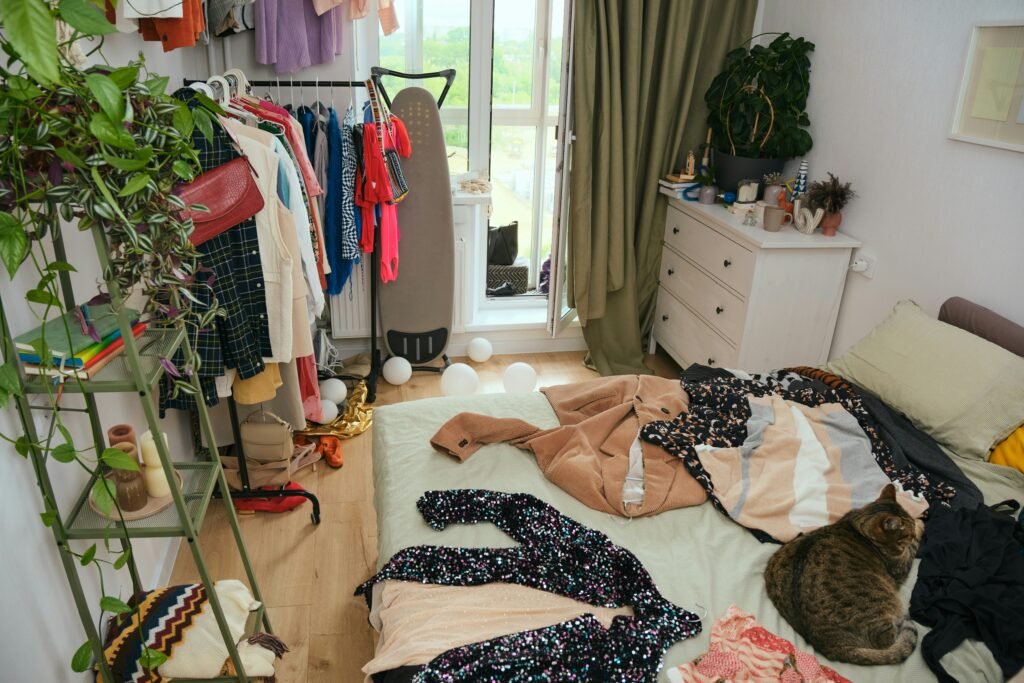
If the same thing keeps accumulating in the same place, you can keep trying to stop yourself doing it, or you can ask why it keeps happening. Maybe post always lands on the kitchen counter because that is the first flat surface you reach when you come home. Maybe clothes pile up on one particular chair because you need somewhere for things that have been worn but are not ready for the wash. Maybe rubbish appears beside the sofa because the bin is in another room.
Those are all problems you can design around. The post pile might need a tray. The clothes chair might need to become an intentional ‘wear again’ basket or hook. The sofa might need a little bin nearby. The point is not always to eliminate the behaviour. Sometimes the easier answer is to give the behaviour somewhere better to happen.
I think this is one of the biggest differences between organisation that looks good and organisation that actually works. A system can be perfectly logical on paper and still be completely useless if it requires you to behave in a way you have repeatedly demonstrated you do not naturally behave.
Pretty Storage Can Still Be Useless Storage
I love the idea of everything being hidden inside matching containers. I also know that if I cannot see something, there is a reasonable chance I will forget it exists. A beautiful opaque storage box is not especially useful if I open it six months later and discover three things I bought replacements for because my brain had completely deleted the originals.
Sometimes open storage works better. Sometimes a clear container works better. Sometimes the answer is simply leaving something visible because seeing it is what reminds you that it exists. That does not necessarily make the room look as perfectly organised as the version you saved on Pinterest, but Pinterest does not have to live in your house. You do.
The best organisational system is the one you actually use, even if it looks slightly less impressive.
Stop Creating Extra Steps
A lot of organisation problems are really friction problems. Putting something away might technically only take thirty seconds, but if it requires opening a cupboard, moving another thing, finding the correct container, opening that container and then putting everything back together again, it suddenly feels like a task.
That matters, especially with things you have to do repeatedly. If a system keeps failing, count the steps. If your normal behaviour takes one step and the organised version takes six, you are asking yourself to choose the harder option every single time.
Sometimes the answer is hooks instead of hangers. Sometimes it is an open basket instead of a drawer. Sometimes it is keeping something out rather than repeatedly putting it away and getting it back out again. You are allowed to choose the version that requires less effort. Organisation is supposed to reduce friction, not manufacture more of it.
Fantasy You Also Goes Food Shopping
This is possibly where the Fantasy Self causes the most expensive damage. You go shopping feeling optimistic and buy food for the version of yourself who is definitely going to cook every night this week. She buys ingredients, vegetables and things that require chopping. Then Wednesday arrives and Actual You opens the fridge, sees an aubergine that requires some kind of plan and orders food instead.
I have started thinking of this as aspirational grocery shopping. There is nothing wrong with trying new food or wanting to cook more, but if you throw away the same things every single week, that is useful information. Maybe pre-chopped vegetables work better. Maybe microwave rice gets eaten and uncooked rice doesn’t. Maybe grated cheese is worth paying slightly more for because the block somehow remains untouched until it becomes a science experiment.
The theoretically cheapest option is not actually cheaper if you repeatedly throw it away. Buying for the person who will really be standing in your kitchen on Wednesday night is often much more useful than buying for the person you hope you’ll become by then.
Your Planner Does Not Need Another Chance
I have a particular weakness for organisational systems that require me to become extremely organised before I can use them, and planners are a perfect example. There is something about a new planner that makes it feel as though this one might finally transform everything. This one will contain appointments, finances, meals, habits, goals and possibly the entire future.
For the first few days, it is immaculate. Then I forget to open it. A month later, I find it and experience mild guilt about all the empty pages.
At some point, you have to stop blaming yourself and ask whether the planner actually suits the way you function. Maybe you need something digital because you always have your phone. Maybe you need a wall calendar because you need information to stay visible. Maybe you need a notebook with absolutely no system beyond writing things down. Or maybe you do not need another planner at all.
That is also an option.
Build Around What You Already Do
One of the easiest ways to make organisation work is to stop asking yourself to behave completely differently. Look at what you already do and make that behaviour slightly more useful.
If you always drop your keys in the same place, put something there to hold them. If you always take your clothes off beside the bed, put the laundry basket there. If you always forget to take things upstairs, keep a basket for things that need moving between floors. If you always leave certain products out because you use them every day, give them an intentional place instead of repeatedly hiding them and getting them back out again.
You are not trying to win against your natural behaviour. You are trying to make it work for you.
Ask Why Before You Buy Another Storage Box
When something keeps going wrong, my first instinct used to be to buy something that promised to organise it. Now I think the more useful first question is simply: why is this getting messy?
Is there genuinely not enough storage, or is the storage somewhere inconvenient? Do you need another container, or are you avoiding putting things away because the container already has too many steps? Do you need a bigger wardrobe, or do you just hate folding clothes?
Buying something can absolutely solve an organisational problem, but it helps to know what problem you are actually solving first. Otherwise, you can end up with the same mess sitting inside considerably nicer boxes.
Organisation Should Make Life Easier
That is the standard I want to use now. Not whether something looks organised, not whether it is how somebody else would do it and not even whether it is the ‘correct’ place for something. The only question that really matters is whether the system makes life easier.
If keeping a basket beside the sofa means things actually get put somewhere, good. If you need three laundry baskets, fine. If your skincare lives in the bedroom, nobody is coming to arrest you. If your wardrobe works better when half your clothes are not folded, stop folding them.
Organisation is supposed to reduce the amount of effort required to live in your space. It should not become another standard you constantly fail to meet.
So stop building systems for the imaginary version of yourself who always does everything properly. Look at the person who actually lives there.
She is the one the system needs to work for.